Texas Food Truck License Requirements After HB 2844: A Compliance Checklist for Mobile Vendors
Step-by-step checklist for Texas food truck license requirements under HB 2844: DSHS license, inspections, staff training options, and the local rules mobile vendors still must follow.

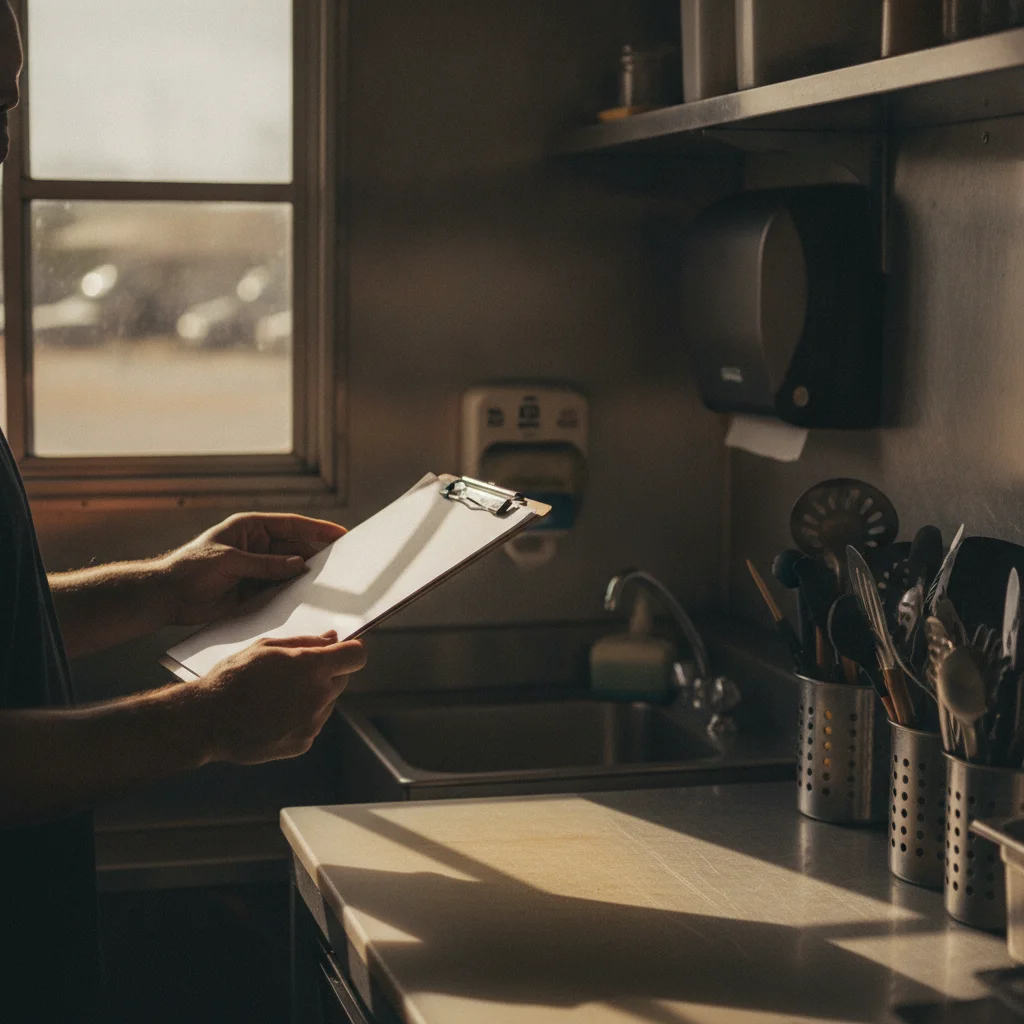
title: "Texas Food Truck License Requirements After HB 2844: A Compliance Checklist for Mobile Vendors" slug: "texas-food-truck-license-requirements-hb-2844-checklist" meta_description: "Step-by-step checklist for Texas food truck license requirements under HB 2844: DSHS license, inspections, staff training options, and the local rules mobile vendors still must follow." keyword_target: "texas food truck license requirements hb 2844" vendor_ids: ["servsafe", "statefoodsafety"] hero_image: "/blog/texas-food-truck-license-requirements-hb-2844-checklist.webp" hero_image_alt: "Texas food truck operator reviewing an inspection checklist beside a thermometer and stainless-steel prep station" design_variant: "editorial" published_at: "2026-10-01"
Texas Food Truck License Requirements After HB 2844: A Compliance Checklist for Mobile Vendors
Sorting out Texas food truck license requirements after HB 2844 starts with your operation: what you serve, how you prepare it, and whether you already hold a local license. Use this checklist to organize the paperwork, inspection preparation, staff training, and location checks before committing to your next service date.
30-Second Read
If you already operate under a local license, check the conditions for continuing during the DSHS transition; if you are starting fresh, plan around the required pre-licensing inspection. DSHS explains both routes. For staff training, consider ServSafe for its published language options or StateFoodSafety for its documented phone and tablet support, after confirming the credential your employee needs.
What HB 2844 changed for Texas mobile food vendors
Statewide DSHS licensing began July 1, 2026. The enrolled law requires a separate license for each food vending vehicle and preserves nonconflicting local requirements. Read the enacted provisions.
Keep separate folders for the vehicle license, employee credentials, and location approvals. That is a practical filing recommendation: when someone requests a document, you should be able to produce the right one without digging through course receipts.
Who needs the DSHS license: categories and MFV types
Start by checking whether your setup qualifies as mobile. DSHS defines the operation around a readily movable food vending vehicle serving food or drinks for immediate consumption. Its classification guidance explains why permanent attachments and utility connections can matter. Do not assume that a trailer qualifies simply because it still has wheels.
The transition categories concern your existing license:
- Category One: Existing local license holders can continue under the stated conditions: provide license proof, apply, pay, and keep the application summary aboard.
- Category Two: Applicants without a current Texas license cannot operate until the pre-licensing inspection is completed.
These conditions come from the DSHS transition instructions. Confirm your eligibility if your previous permit has expired.
The food classifications are a separate question. The enrolled law broadly distinguishes Type I prepackaged or low-risk operations, Type II limited preparation, and Type III preparation, cooking, holding, and service.
An important source discrepancy: The DSHS web summary and its vendor guide describe some prepackaged temperature-controlled foods differently. Ask DSHS to classify your actual menu and packaging before selecting a fee tier.
Get the weekly RestaurantTools digest
Vendor-neutral software comparisons and honest data from our scan of 238,000+ US restaurant websites, deduplicated to 71,000+ unique US locations.
Fees and what to budget for licensing
The following amounts are listed in the DSHS fee schedule:
| Classification | Application fee | Pre-licensing inspection fee |
|---|---|---|
| Type I | $309 | N/A |
| Type II | $618 | $400 |
| Type III | $876 | $500 |
DSHS lists routine and complaint/compliance inspection charges separately in that same schedule. Treat the application payment as one budget line, not your entire opening budget.
Build a separate worksheet for training, insurance, equipment corrections, servicing arrangements, and location expenses. Get quotes for your truck rather than using another operator's total as a promise.
Pre-licensing inspection checklist
Prepare the application packet first. The DSHS application walkthrough calls for vehicle insurance, applicable commercial vehicle documents, the driver's license, a menu, and an itinerary. Existing permit holders must also supply their previous permit information and upload a copy.
For inspection day, the DSHS vendor guide identifies these preparation items:
- Employee health policy and food allergen poster.
- Food manager and handler credentials, as applicable.
- Preparation-facility or servicing documentation, as applicable.
- Appropriate water, handwashing, warewashing, temperature-control, and waste arrangements.
- Accessible employee restrooms and approved food sources.
Use the official checklist against your actual equipment. Walk through a full service: receiving ingredients, storing them, preparing orders, washing utensils, and closing down. Write down any step where the setup leaves you guessing.
A commissary exemption is conditional. The enrolled law ties it to compliant onboard equipment and proper grease and cooking-waste disposal. The DSHS guide includes an exemption checklist. Resolve that question before signing or canceling a commissary agreement.
Staff food handler training: ServSafe vs StateFoodSafety
DSHS says many food service employees must complete accredited food handler training within 30 days of starting work. Establish each person's training requirement before buying seats.
The comparison below uses official pages checked for this article. We have not independently tested these courses, so these are vendor-published details.
| Buying consideration | ServSafe | StateFoodSafety |
|---|---|---|
| Texas offering | Texas Online Course and Assessment | Online Texas food handler training |
| Published price | $15 for the listed Texas online course | No price verified from the reviewed Texas overview; check the selected course |
| Languages | English, Spanish, simplified Chinese, Korean, Vietnamese | English and Spanish; other languages depend on location |
| Device information | Check the linked technical requirements before purchase | Phone and tablet compatibility explicitly documented |
| Training scope | Food handler course | Food handler training does not provide food manager certification |
If your employee needs one of ServSafe's listed languages, consider that course. If phone access is the deciding factor, consider StateFoodSafety's documented device support. Neither detail establishes better teaching or higher pass rates; no comparative results were available.
Before checkout, confirm the exact course, accepted credential, language, total price, and certificate retrieval process. Keep a staff training register with completion and expiration details.
Local requirements that still apply after HB 2844
The enrolled law retains applicable fire codes, location restrictions, and zoning codes. A statewide food license does not answer every question about a particular parking spot.
Before agreeing to a site, ask the relevant local offices which rules apply to that address and operation. Describe your cooking equipment and intended service setup. Request written guidance and keep it with the booking paperwork.
Do not assume every local health inspection request is improper, either. The law allows local authorities to conduct inspections under agreements with DSHS.
Step-by-step compliance timeline
Use milestones rather than an assumed approval date:
- Set the menu and operating model. Document preparation, storage, packaging, and intended locations. Confirm classification before paying.
- Assemble the packet. Follow the DSHS application walkthrough, including its itinerary and attachment instructions.
- Submit and save the records. Retain copies of everything entered or uploaded, plus payment confirmation.
- Prepare for inspection. Work through the official inspection and commissary checklists. Address unresolved items with the inspector.
- Confirm readiness for service. Check your authorization to operate, staff credentials, and location arrangements before announcing an opening date.
Assign an owner to each unfinished item. A checklist with names and document locations is more useful than a folder full of unread downloads.
Get the weekly RestaurantTools digest
Vendor-neutral software comparisons and honest data from our scan of 238,000+ US restaurant websites, deduplicated to 71,000+ unique US locations.
What real operators say
We did not find operator comments about these training providers. We have not substituted invented testimonials or presented vendor statements as customer experience. This comparison therefore makes no claim about operator satisfaction with either training provider.
FAQ
Does my existing city permit automatically become a DSHS license?
Do not treat it as an automatic conversion. The DSHS application instructions require previous local permit details and a copy as part of the application process.
Does a permanently parked trailer qualify as a mobile food vendor?
Its actual setup matters. DSHS says the vehicle must remain readily movable; its mobility guidance addresses attachments and utility connections. Have DSHS assess your configuration before assuming the mobile licensing route applies.
Will buying a food handler course cover food manager certification?
Do not assume so. StateFoodSafety explicitly distinguishes its food handler course from food manager certification. Identify the required credential first, then buy the matching product.
Which training provider is cheaper?
ServSafe lists its Texas online course at $15. A comparable StateFoodSafety price was not verified on the reviewed overview, so there is no supported price winner here.
For practical restaurant operating checklists and training comparisons, join the RestaurantTools.ai newsletter.
Disclosure
This comparison is vendor-neutral and distinguishes official requirements from vendor-published course details. RestaurantTools.ai may earn commissions through affiliate links. Requirements were checked against official sources; no operator testimonials were available. Confirm classification and operating authorization with DSHS for your specific setup.
Sources
- DSHS: Mobile Food Vendors and fee schedule — typ: external
- Texas Legislature: HB 2844 enrolled text — typ: external
- DSHS: Who Should Be Licensed as a Mobile Food Vendor? — typ: external
- DSHS: Mobile Food Vendor Guide — typ: external
- DSHS: How to Submit an MFV Application — typ: external
- DSHS: Licensing of Food Handler Training Programs — typ: external
- ServSafe: Texas Food Handler Program catalog — typ: vendor
- StateFoodSafety: Texas Food Handler Training — typ: vendor
About RestaurantTools.ai Research Team
RestaurantTools.ai is a vendor-neutral comparison platform for restaurant software. Our rankings are grounded in proprietary adoption data from scans of 238,000+ US restaurant websites, deduplicated to 71,000+ unique US locations (see our restaurant technology statistics), pricing verified against vendor pages, and operator reviews - AI-assisted research under strict no-fake-data editorial rules, so independent operators can pick tools without sitting through 5 demos.
You might also like

Best POS for Food Trucks in 2026: Offline Payments Are the Whole Game
Food truck POS compared for 2026: Square, PayPal POS, SumUp, Toast Go, Clover Flex, Loyverse - true offline card capture, LTE hardware, real costs per ticket.
Restaurant Employee Meal Policy: Setting Rules Your POS Can Track
Build a restaurant employee meal policy your POS can enforce — eligibility, allowances, and approvals tracked in Toast, Lightspeed, or Flipdish.

Ada Chatbot Pricing: A Quote Checklist for Guest Support Teams
Evaluate Ada chatbot pricing against Intercom and Zendesk, understand billing units, and prepare the right quote questions for your guest support team.